
Decode
CE 0359 Ex II 2 G Ex d IIC T4 Gb
TL;DR
ATEX/IECEx nameplates are compact passports. They tell you: EU compliance (CE), the ATEX notified body (four-digit number), the specific Ex mark, the equipment group & category (e.g.,
II 2 G), the protection concept (Ex d), gas/dust group (IIC), temperature class (T4) and the equipment protection level (Gb).Master one string—like CE 0359 Ex II 2 G Ex d IIC T4 Gb—and you can read them all.
1. Example nameplate
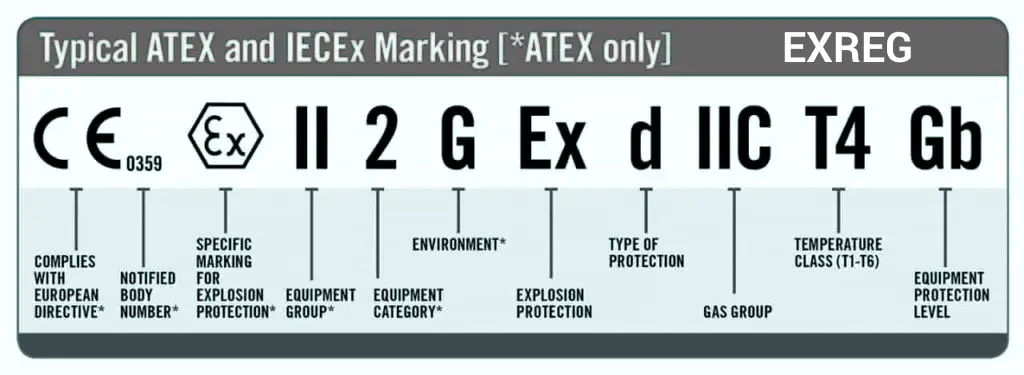
CE 0359 Ex II 2 G Ex d IIC T4 Gb1.1 Marking breakdown
| Mark | Meaning | Zone / EPL alignment | Notes |
|---|---|---|---|
CE | Conformité Européen — product complies with applicable EU directives | — | For ATEX equipment, CE covers 2014/34/EU + any other applicable directives. |
0359 | Notified Body ID (for production QA surveillance) | — | Four-digit NB number placed next to CE when the NB audits ATEX quality system. |
Ex (stamp) | Specific explosion-protection mark (hexagon “Ex” symbol) | — | Indicates equipment is intended for explosive atmospheres under ATEX. |
II | Equipment Group II (surface industries) | — | Group I is for underground mines. |
2 | ATEX Category 2 (high protection) | Zone 1 (also 2) | Category 1 → Zone 0; Category 3 → Zone 2. |
G | Gas/vapour atmosphere (vs D for dust) | — | Often shown together as 2G. |
Ex | Explosion-protection per IEC 60079 series | — | Precedes the protection concept letters. |
d | Protection concept: flameproof enclosure (Ex d) | Typically EPL Gb | Some labels show db (concept + level); both depend on the certificate edition. |
IIC | Gas group (Hydrogen/Acetylene — most stringent) | — | IIA = Propane; IIB = Ethylene; IIC = Hydrogen/Acetylene. |
T4 | Max surface temperature ≤ 135 °C | — | Choose T-class ≤ the substance’s auto-ignition temperature. |
Gb | Equipment Protection Level | Zone 1 | Ga → Zone 0 • Gc → Zone 2. For dust: Da/Db/Dc. |
Bottom line: CE 0359 Ex II 2 G Ex d IIC T4 Gb describes a surface-industry device for Zone 1 gas areas, using flameproof construction suitable for tough gas group IIC, limited to T4 surface temperature, with EPL Gb.
2. Gas groups & examples
| Group | Typical substances | Notes |
|---|---|---|
| IIA | Propane, petrol vapours | Least demanding |
| IIB | Ethylene | Intermediate |
| IIC | Hydrogen, acetylene | Most stringent clearances |
3. Temperature classes (T-class)
| T-class | Max surface temp | Example gases |
|---|---|---|
| T1 | ≤ 450 °C | Methane |
| T2 | ≤ 300 °C | Ethane |
| T3 | ≤ 200 °C | Diesel, kerosene |
| T4 | ≤ 135 °C | Ethyl ether |
| T5 | ≤ 100 °C | — |
| T6 | ≤ 85 °C | Carbon disulphide |
4. EPL, ATEX category & Zones
| Zone | EPL (gas) | ATEX category | Presence of explosive atmosphere |
|---|---|---|---|
| Zone 0 | Ga | 1G | Continuous / long periods |
| Zone 1 | Gb | 2G | Likely in normal operation |
| Zone 2 | Gc | 3G | Unlikely / short duration |
| Zone 20 (dust) | Da | 1D | Continuous / long periods |
| Zone 21 | Db | 2D | Likely in normal operation |
| Zone 22 | Dc | 3D | Unlikely / short duration |
5. Dust example & mining variant
Dust nameplate: II 2D Ex tb IIIC T125°C Db — Category 2 for dust, protection by enclosure (tb),
conductive dust group (IIIC), surface limit 125 °C, EPL Db.
Mining (Group I): I M2 Ex db I Mb — for mines, de-energised in faults (M2), flameproof, coal-dust group I, EPL Mb.
6. Frequent pitfalls
- T-class vs process temp: T-class limits the device’s surface, not your process setpoint.
- Uncertified glands: a compliant enclosure with a non-Ex gland is no longer compliant.
- Painted flamepaths (Ex d): any coating on mating faces invalidates the concept.
- Mixing IS and non-IS: keep Ex i circuits segregated; use blue IS glands.
- Wrong zone assumption: verify the area’s zone/EPL before procurement; don’t rely on legacy tags.
7. Quick nameplate checklist
- Group & Category (
II 2 GorII 2 D) match the area classification. - Protection concept appropriate (Ex d/e/i/p…).
- Gas/Dust group correct (IIC/IIIC where required).
- T-class / surface limit ≤ ignition temperature at site conditions.
- EPL present and correct (Ga/Gb/Gc or Da/Db/Dc).
- ATEX/IECEx certificate numbers readable and traceable.
8. Further reading
- EUR-Lex: ATEX Product Directive 2014/34/EU
- EUR-Lex: ATEX Workplace Directive 1999/92/EC
- IECEx Certificate of Conformity database: iecex.com
- Related guides: EX Zones explained • ATEX vs IECEx • EX Inspections
9. Conclusion
Reading an Ex nameplate is a five-minute skill that prevents years of compliance pain. Once you can decode CE 0359 Ex II 2 G Ex d IIC T4 Gb, you can validate almost any tag you see in the field.